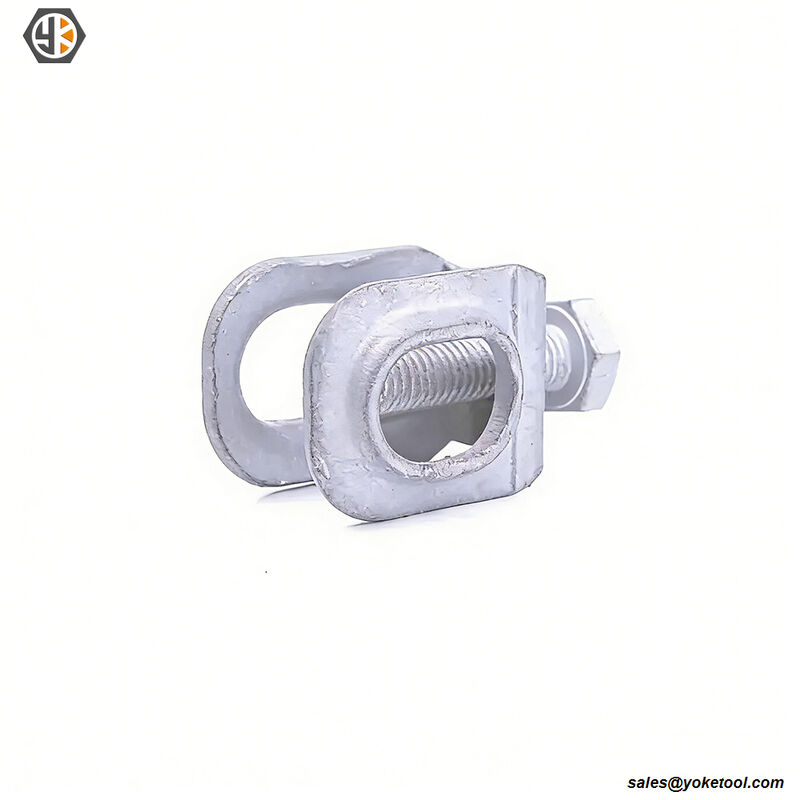
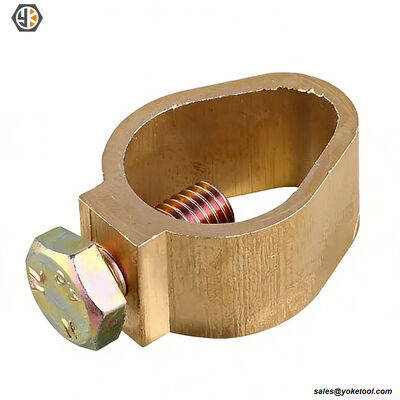
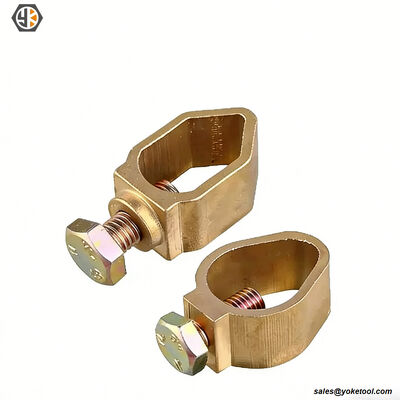
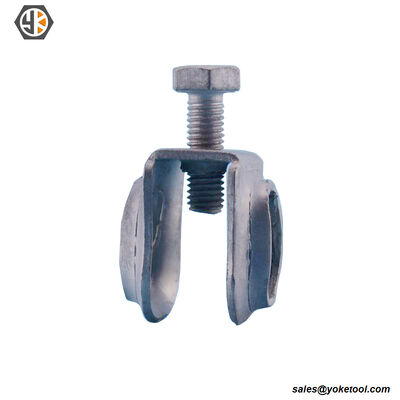
Production Process of Ground Rod Clamp
Material Preparation: Select high-quality brass, copper alloy or galvanized steel strip as raw material.
Stamping & Forming: Use a press to stamp and bend the material into the clamp body, connecting plate and fastening structure.
Drilling & Tapping: Drill mounting holes and process thread holes for bolts.
Deburring & Polishing: Remove burrs and polish the surface to ensure smooth contact.
Assembly: Match and assemble with hex bolts, nuts and spring washers.
Surface Treatment: Galvanizing or tin plating for corrosion resistance.

Yokelink Quality Control and Testing Equipments
We don't just reference standards; we also verify them in practice: each batch of products undergoes destructive tensile testing in our internal laboratory to ensure load performance exceeds the minimum requirements of IEEE C135.2 or CSA specification; we use optical comparators to ensure the geometric accuracy of chamfered tips and rolled threads, enabling convenient on-site installation; at the same time, we conduct comprehensive testing on Rockwell hardness, coating thickness, and other parameters, and each shipment is accompanied by the original manufacturer's material specifications (MTRs) and quality inspection reports, with all data traceable back to the raw material furnace number.
The Application of Ground Rod Clamp
Ground rod clamps are essential connectors used in grounding and lightning protection systems. They securely connect copper-bonded ground rods, ground wires, and flat steel conductors to form a reliable grounding network. Widely applied in substations, power distribution lines, communication base stations, buildings, and industrial facilities, they ensure low electrical resistance and stable current conduction. Made of corrosion-resistant materials, they maintain excellent conductivity and long service life in outdoor and underground environments. These clamps meet IEEE and ASTM standards for safe and stable grounding performance.
Yokelink Product Quality Inspection Report
We provide comprehensive inspection services for machine bolts, including SGS test bolts and formal Production Part Inspect Report (PPIR). The SGS tests verify the bolts’ compliance with international standards like ASTM A307 and IEEE C135.80, covering mechanical properties and corrosion resistance. The PPIR details all inspection items, ensuring each machine bolt meets dimensional, performance and quality requirements, providing reliable quality assurance for overhead line and industrial applications.
Technical Specifications of Ground Rod Clamp
| Part No. |
Rod Size |
Ground wire |
Weight |
| Inch |
Inch |
Kg / Pcs |
| E0612 |
1/2 |
2-10 AWG |
0.040 |
| E0658 |
5/8 |
8-1/0 AWG |
0.045 |
| E0634 |
3/4 |
8-1/0 AWG |
0.048 |
| E0656 |
1/2 to 3/4 |
8-2/0 AWG |
0.288 |
| E06316 |
3/16 to 1/2 |
|
0.275 |
Cross Reference (Industry Equivalents):
| Rod Size |
Part No. |
HUBBELL |
MACLEAN |
| Inch |
| 1/2 |
E0612 |
|
J8491 |
| 5/8 |
E0658 |
|
J8492 |
| 3/4 |
E0634 |
|
J8493 |
| 1/2 to 3/4 |
E0656 |
|
|
| 3/16 to 1/2 |
E06316 |
|
J7956 |
(Note: Manufacturer part numbers are for reference only. Yokelink products are interchangeable based on IEEE standards.)
Frequently Asked Questions (FAQ)
Q1: Why is a ground rod clamp often called an "Acorn Clamp"?
A: It is a common industry nickname derived from the clamp's physical shape. The tapered, oval-like cast bronze body resembles an acorn. This design is highly functional, allowing the clamp to slide over the ground rod and use a single bolt to compress the ground wire tightly into the V-groove against the rod.
Q2: Can I use a standard galvanized clamp on a copper-bonded ground rod?
A: No, this is highly discouraged. Mixing dissimilar metals (like zinc-galvanized steel and copper) in a moist underground environment will trigger galvanic corrosion. This causes the metals to degrade rapidly, destroying the electrical connection. You must always use a bronze or copper-alloy clamp (like the Yokelink Acorn Clamp) with a copper-bonded ground rod.
Q3: What does "Direct Burial Rated" mean for a ground clamp?
A: A "Direct Burial" rating (often associated with UL 467 compliance) means the clamp is manufactured from highly corrosion-resistant materials, such as silicon bronze and stainless steel, that will not degrade when continuously exposed to soil, moisture, or encased in concrete. It ensures the grounding connection remains secure and conductive for decades underground.
Value-Added Supply Chain Services
1. Blanket Order & Free Warehousing
Yokelink offers Blanket Order programs: Place an annual order to lock prices, we manufacture your total volume and hold stock in our facility free of charge. Split Shipments: Schedule partial shipments (e.g., monthly or quarterly) based on your project progress. You get the benefits of just-in-time delivery without the risk of shortages.
2. DDP Shipping (USA Duties Included)Landed Cost Certainty: We handle the complex logistics. Our DDP (Delivered Duty Paid) service covers sea freight, US Customs clearance, and Section 301 tariffs. The price we quote is the final price delivered to your door / Warehouse.
3. Free Sample Program
We offer Free Samples to qualified commercial buyers for testing and approval.
Reference Information:
The Truth About Ground Rods: Copper-Bonded vs. Galvanized for Long-Term Earthing
Triple eye Anchor Rods: The Ultimate Guide for guy Wire and Structural Stability